

By Mihika Wagle (03/09/26) — London, UK
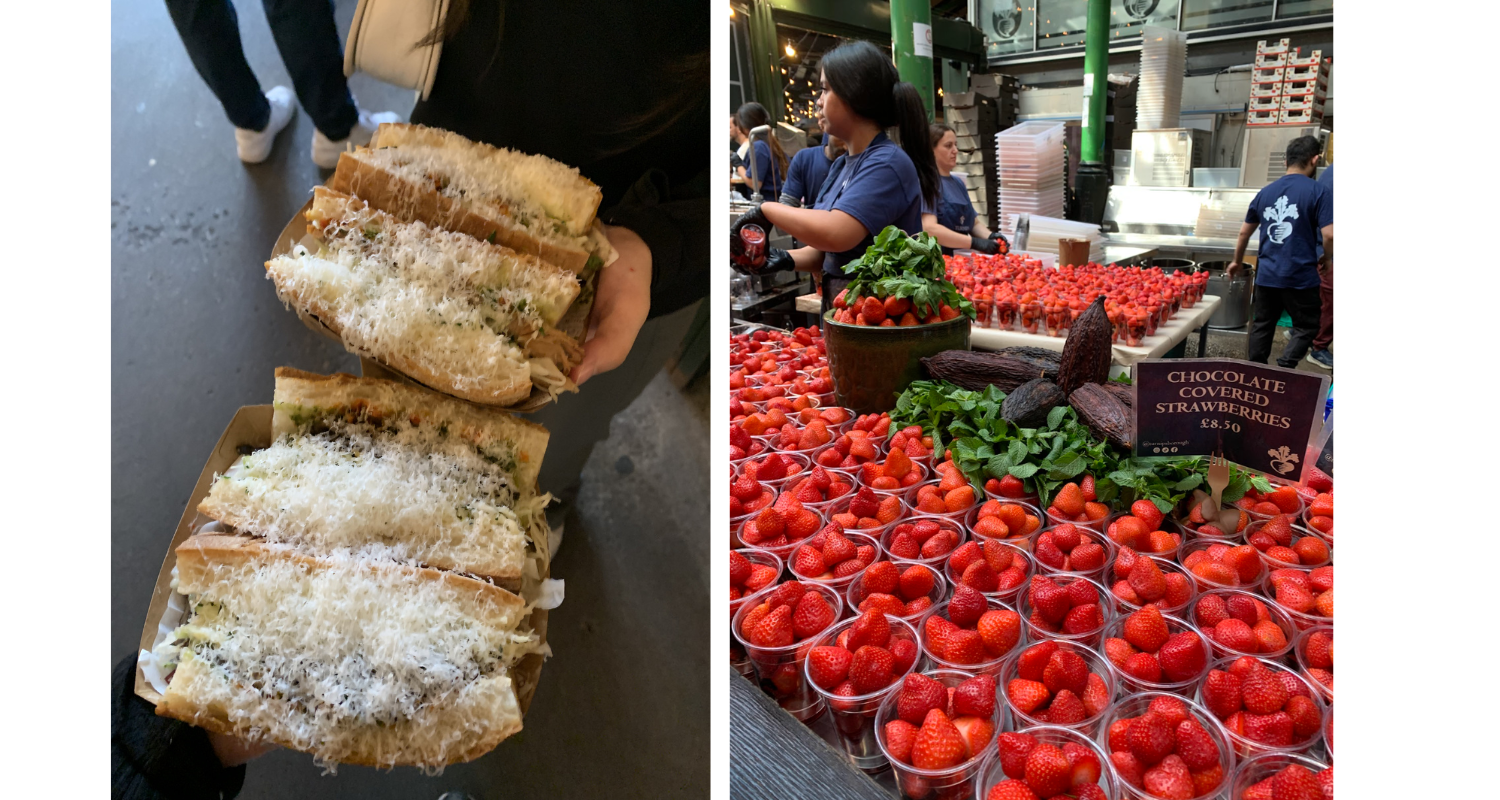
The Borough Market: long lines, packed stalls, and busy workers.
Commonly referred to as London’s premier food market, the Borough Market is a place where you simply don’t know what to try first. It was around closing time on a Friday, and even though my friends and I were all cold from the infamous London rain, I couldn’t feel anything but awe as I stared at the crowd around me.
As I looped around the area to find the world-famous chocolate strawberries, I saw something curious: people in purple uniforms getting out of a truck. It was my turn to pay, so I didn’t think much of it until I saw the same people at the fresh-squeezed juice stand.

Eventually, after seeing them two more times, my curiosity got the best of me, and I asked the worker at the mushroom risotto stall why they were here.
As it turns out, these purple-uniformed heroes work for Plan Zheroes: the heart of the food waste management system throughout the Borough Market.
He pointed to a stack of crates behind him. The bread in them looked too perfect to be thrown away. The worker explained that “they come every evening…anything [the vendor] can’t sell but is still good, they take it. It goes to shelters and community kitchens.”
Plan Zheroes works with traders across the market to make sure surplus food doesn’t end up in the trash. Instead, it ends up on plates, making it simple but powerful.
I started to wonder if anyone else knew this was happening.
The first person I asked, Beth, was balancing a cardboard tray of paella in her hands. When I told her that the market donates unsold food every single day, her eyes widened. “I honestly just assumed markets like this throw loads away.” She paused and then grinned, exclaiming that “That actually makes [her] like it more.”
A few stalls down, I stopped a man, Richard, in a suit who looked like he had just escaped from a long workday. I asked if he knew about the food waste management system at the Borough market. He shook his head and said that “[he’s] seen the recycling bins, but [he] didn’t realize there was an organized system behind the scenes.” I explained how volunteers collect leftovers from stall to stall at closing time. He felt that it was “impressive and they should talk about it more.”
Later, near the juice stand where I had first noticed the purple uniforms, I asked a mother and her daughter if they were aware of any sustainability initiatives at Borough Market. The daughter shrugged, and the mother guessed composting or recycling. When she found out about these unseen heroes, she seemed surprised. “You don’t really see that part, you just see the food”, she admitted.
And that was the pattern. Everyone supported sustainability. No one really saw it.
Beyond the partnership with Plan Zheroes, Borough Market has built quieter systems into its everyday rhythm, which include separated waste streams and clear recycling points. They also encourage traders to minimize single-use plastics and redistribute edible surplus. Some stalls even discount items toward closing time so that less food is left behind. None of it is flashy. No giant banners are announcing it. It just happens.
As it got darker and the crowds thinned, I noticed the purple uniforms again. Crates were lifted, sorted, and loaded. Workers said quick goodbyes. The market that had felt chaotic an hour earlier now moved with quiet efficiency.
Standing there, I realized that sustainability at Borough Market doesn’t demand attention. It doesn’t interrupt your search for chocolate strawberries or your debate over which pastry to try. It works in the background, woven into the closing rituals of each stall.
The Borough Market may be defined by its packed aisles and buzzing energy, but tucked between the fresh bread and sizzling pans is something else entirely, a system designed to make sure that even at closing time, the story of the food doesn’t end in a bin.
