

By Leann Lam (03/29/26) — Shanghai, CN
By the time my classes end, I return to my dorm around 6 p.m., exhausted and hungry. Like many students in Shanghai, I open Meituan, one of China’s most popular food delivery apps. In recent years, China's food delivery market has experienced explosive growth, reaching 1.5 trillion yuan (US$208 billion) in 2023 (Yang). The platform offers hundreds of options within seconds. I scroll through pages of restaurants until a bowl of noodles catches my attention, promising delivery within 15 minutes. Without much thought, I click “confirm order.”
A few minutes later, I head downstairs to retrieve my food from the delivery locker in my dorm building. As I approach the lockers, I notice a delivery worker who is visibly out of breath. Quickly, he places an order inside the Meituan locker and immediately pulls out his phone to check his next delivery. Within seconds, he is already moving again, racing against the clock.
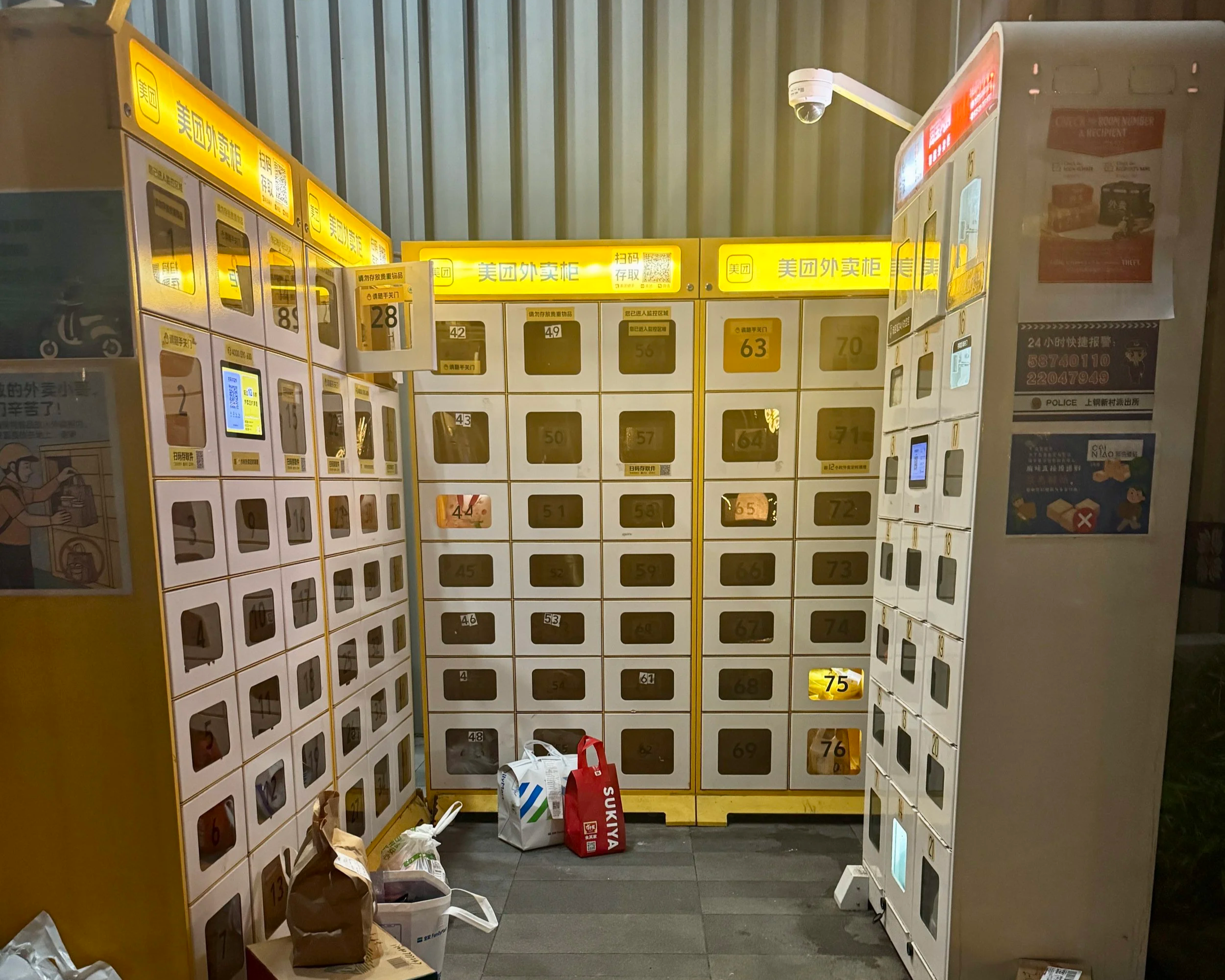
Meituan lockers on the NYU Shanghai campus
His urgency became clearer to me after I interviewed a Meituan delivery driver whom I was lucky enough to catch on a break. During our conversation, he explained that many drivers have to work more than 10+ hours a day just to make a living because the company takes a big cut out of each delivery fee. According to one driver’s account, workers may only get “5 kuai out of a 15 kuai job” (Chenkuang). The industry is built on the digital exploitation of the country's delivery riders as China’s food delivery industry is notoriously cutthroat (Yang).
The pressure doesn’t end here. Late deliveries can result in multiple bad ratings. This can lead to a temporary suspension of their accounts, halting their only source of income. Algorithms track their performance constantly, leaving little room for rest or mistakes. In this system, efficiency is prioritized over worker well-being.
When I return to my room and open the insulated bag, I see the same logic reflected in the packaging: single-use plastic gloves, disposable chopsticks, food containers tightly wrapped in plastic. What initially feels convenient feels excessive. As Guo states, “China’s three largest catering platforms, Meituan, Eleme, and Baidu, receive 20 million takeout orders daily and consume about 60 million plastic products”. Each order may seem small, but all together they create an incredible amount of waste. These platforms are designed to optimize speed, not sustainability, leaving little room for reusable materials or environmentally conscious delivery practices.
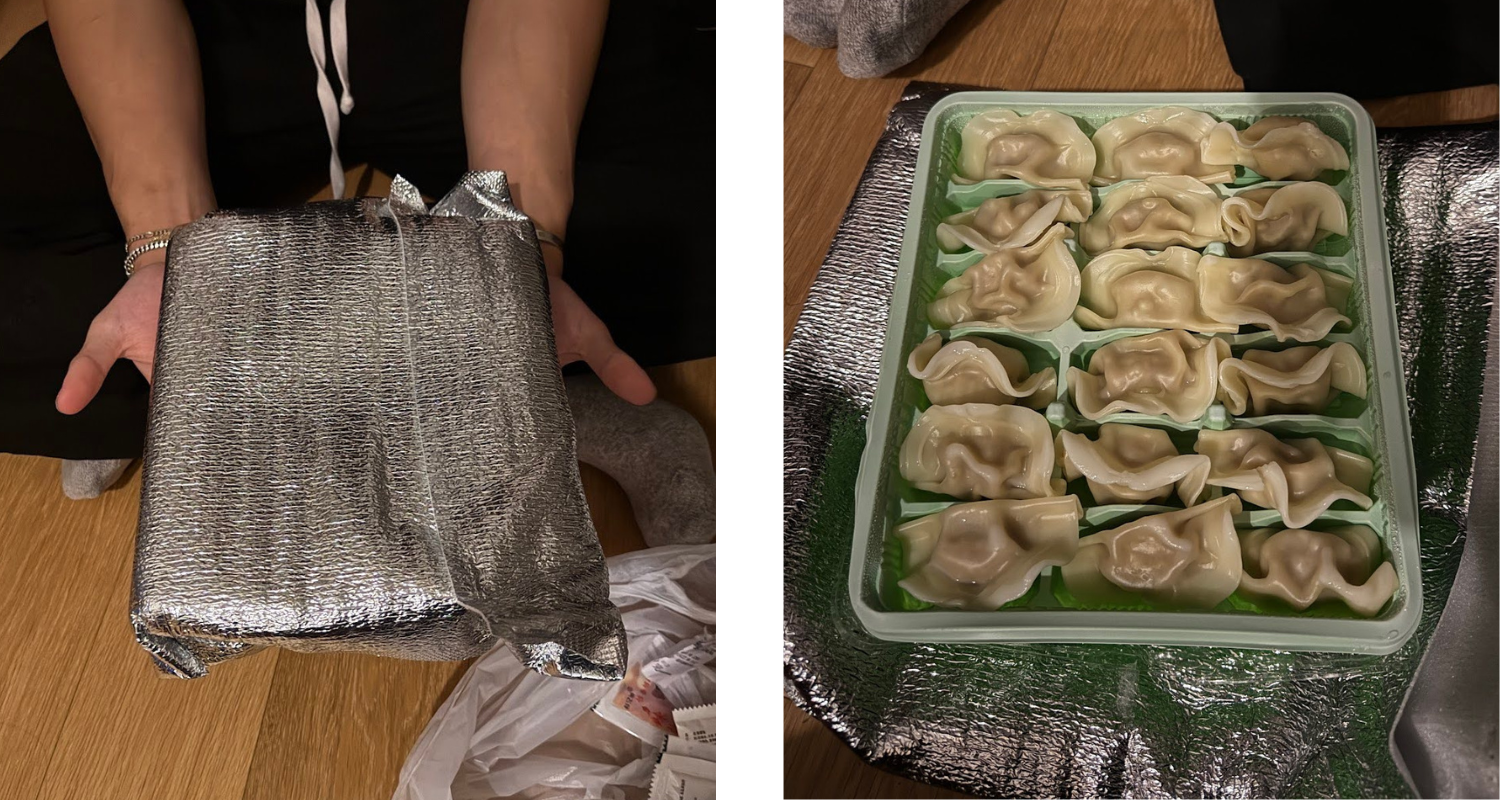
An example of nice, but excessive packaging
The structure of food delivery platforms makes these challenges difficult to address. Algorithmic systems prioritize efficiency, rewarding drivers who complete more orders in less time while penalizing delays. At the same time, consumers have become accustomed to extremely fast delivery times, sometimes expecting meals to arrive within twenty minutes or less. This demand creates pressure that moves through the entire system—from the platform, to the driver, to the packaging and logistics infrastructure that supports the delivery. What appears to be a simple digital convenience is actually supported by a network that encourages rapid consumption, constant movement, and intense labor pressure.
Packaging waste further highlights the environmental cost of this convenience. Because these items are designed for speed and hygiene, they are rarely reusable or recyclable in practice. When multiplied across millions of daily orders, the result is an enormous stream of single-use waste that contributes to growing environmental challenges in urban areas.
Recognizing these hidden costs raises important questions about how delivery systems might evolve to become more sustainable. Some companies have begun experimenting with reusable container programs, in which customers return packaging that can be cleaned and used again. Starbucks has created a program where customers can bring their own reusable cup to the store, which would be filled with their drink rather than using a single-use plastic cup. Other companies have introduced options that give customers incentives to opt out of disposable utensils or choose slower delivery times that reduce pressure on drivers. While these solutions are still limited, they suggest that convenience and sustainability do not have to be completely incompatible.
Ultimately, my simple dinner order revealed how deeply sustainability is connected to the systems that structure everyday life. While discussions of sustainability often focus on reducing carbon emissions, limiting plastic waste, or protecting natural resources, this example of food delivery in China reveals an important social dimension. The convenience of opening an app and receiving a hot meal within minutes can obscure the environmental waste and labor pressures that make that speed possible. If sustainability is to become a meaningful goal, it requires rethinking not only the materials we consume but also the economic and technological systems that deliver convenience. Only by addressing both the environmental and social dimensions of these platforms can food delivery evolve into a system that is truly sustainable.
Works Cited
Chenkuang, Huang. “A day in the life of a Beijing delivery driver.” The China Project, 2021, https://thechinaproject.com/2021/04/13/a-day-in-the-life-of-a-beijing-delivery-driver/.
Guo, Meiwen, Liang Wu, Jianping Peng, and Chun-Hung Chiu. 2021. "Research on Environmental Issue and Sustainable Consumption of Online Takeout Food—Practice and Enlightenment Based on China’s Meituan" Sustainability 13, no. 12: 6722. https://doi.org/10.3390/su13126722
Yang, Calvin. “Long hours, low wages: What is it like to be a gig worker in China's growing food delivery market?” CNA, 1 May 2024, https://www.channelnewsasia.com/asia/long-hours-low-wages-gig-economy-worker-food-delivery-rider-china-4305356.
